



What Is A Defined Outcome ETF?
Defined outcome ETFs use a combination of option strategies to offer a pre-determined payoff profile over a fixed period. At inception, investors know the maximum downside participation as well as the structure of the upside, typically subject to caps or hurdles. These ETFs are designed for those seeking growth participation with embedded protection. Learn more about this product type and how ARK's DIET ETFs are structured in the video.
ARK DIET ETFs Options Curve
Structure Overview
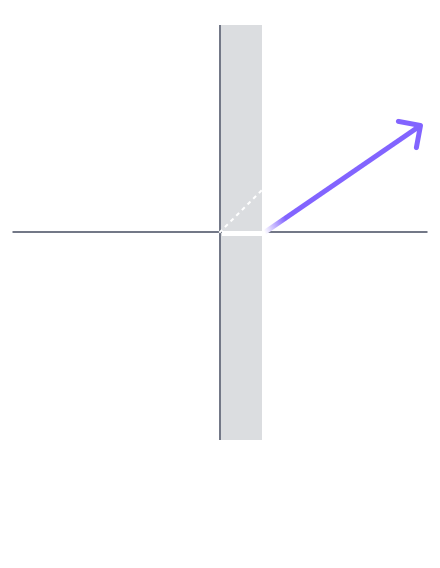
In general, any ARK Defined Innovation Exposure Term (DIET) Buffer ETF will have performance similar to what is illustrated by the options curve, shown here, as compared to the ARK Innovation ETF (ARKK), over the course of one year (the outcome period).
When ARKK has negative performance over the course of a year, the corresponding ARK DIET ETF will decrease only 50% as much as ARKK.
When ARKK returns between 0 and 5%, the ARK DIET ETF will return 0%.
Finally, when ARKK returns greater than 5% (the hurdle), the ARK DIET ETF has a set upside capture percentage (between 50-80%) of any return beyond the hurdle.
For more complete information on the potential outcomes of ARK DIET ETFs please view the prospectus here.
.svg)
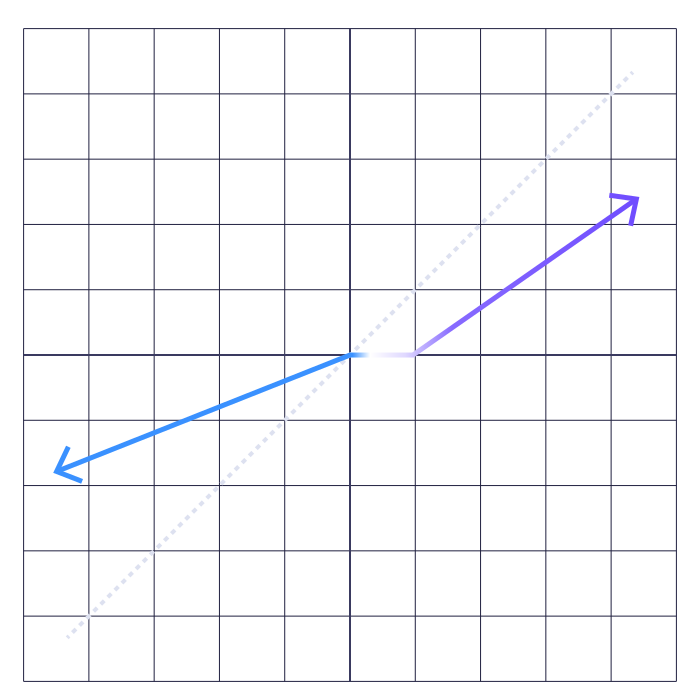
Downside Performance Profile
In a down market (when stock prices are falling), a buffered product is designed to protect investors from experiencing the full extent of the losses. This is where the “buffer” comes into play.
Here’s how it works:
This protection is created using put options, which increase in value when the market goes down. These options give the fund the right to sell at higher prices, offsetting some of the losses in the underlying investment.
In a down market, investors don’t avoid all losses. Investor loss is reduced, however, by 50%. The downside participation rate resets every 12 months, so it applies for one outcome period.
For more complete information on the potential outcomes of ARK DIET ETFs, please view the prospectus here.
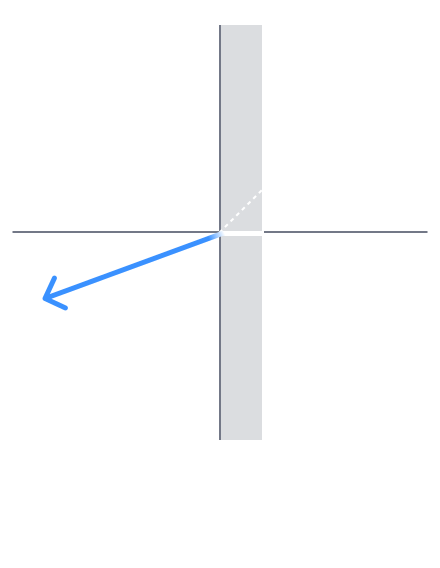
Hurdle (ARKK Performance between 0 and 5%)
Simply, when the ARK Innovation ETF (ARKK) returns 0 to 5% through a given outcome period, the corresponding ARK Defined Innovation Exposure Term (DIET) ETF will return 0%. This 0-5% window is considered the hurdle rate in our options curve.
Because the ARK DIET ETFs offer some downside protection, an investor funds this protection by giving up part of the upside.
In other words, investors are not paying cash for the insurance (the buffer). Instead, investors are paying with the first 5% of gains and by accepting a limit on investors' returns.
This trade-off is what makes an ARK DIET ETF a defined outcome product: investors know how much protection they have, and generally how much upside they’ll get.
For more complete information on the potential outcomes of ARK DIET ETFs please view the prospectus here.
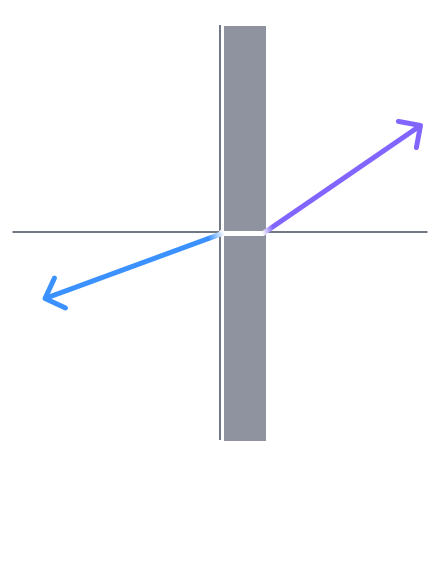
Upside Performance Profile (ARKK Performance Greater Than 5%)
In an up market (when prices are rising), a buffered ETF lets investors participate in gains—but not all of them.
Here’s why:
First, there is usually an upside hurdle—a percentage of gains that you don’t receive. For ARK Defined Innovation Exposure Term ETFs (“ARK DIET”), that’s the first 5% of gains.
After that hurdle, investors get a portion of the remaining gains.
This structure is made using a combination of call options. A short call (sold by the fund) sets the hurdle and fund's downside protection, and a long call (bought by the fund) allows the ETF to participate in upside after the hurdle.
In summary, investors may miss some early gains. Investors participate in the rest, but at a partial rate (for ARK DIET, generally 50–80%). There’s no limit on the upside—but there is reduced participation.
For more complete information on the potential outcomes of ARK DIET ETFs please view the prospectus here.
How Does An ARK DIET ETF Work?
ARK DIET ETFs are designed to give investors exposure to ARK’s innovation strategy with built-in, limited downside protection and a limit on how much of the upside they keep. They work over 12-month periods, with a 50% downside buffer, a 5% upside hurdle, and a 50–80% upside participation rate thereafter. Hear Rahul Bhushan, Global Head of Investment Products, explain more.
ARK DIET ETF Interactive Calculator
Input the ARK Innovation ETF (ARKK)'s performance over a 1-year timeframe (Outcome Period) and see how each ARK DIET ETF would have performed over the same year. For more complete information on the potential outcomes of ARK DIET ETFs please view the prospectus.
For illustrative purposes only, and should not be considered investment advice.
Why Would An Investor Want An ARK DIET ETF?
Buffered ETFs, such as the ARK Defined Innovation Exposure Term (DIET) ETFs, can serve as a tool for managing risk in a traditional investment portfolio. A buffered ETF is designed to be a complement, not a replacement, for an existing ETF portfolio—especially if you already own other ARK funds like ARKK—the ARK Innovation ETF. Learn more about why an investor may want to add an ARK DIET ETF to their portfolio here.

Want To Learn More About The ARK DIET ETFs?
Continue your journey with the ARK DIET ETFs by exploring FAQs, fund resources, and insights.
Educational Videos
Explore more educational videos covering ARK DIET, including video FAQs.
Read Our White Paper
Take a deep dive on options and how we structured the ARK DIET ETFs.
